
Ar Verb Chart
Most Spanish verbs end in -ar, and once you know the pattern you can conjugate thousands of them. Type any -ar verb to see its full chart, with stem-changing and spelling-changing forms highlighted, then practise with the quiz.
- Free to use
- No sign-up
- Runs in your browser
Spanish -ar verb chart
Quiz
Spanish -AR Verb Chart Pack
Printable -ar verb charts for every tense, stem-changing and spelling-change charts, 50 common -ar verbs with meanings, conjugation worksheets with answer keys and blank chart templates.
- All tenses chart (PDF)
- Stem-changers chart (PDF)
- 50 common verbs (PDF/XLSX)
- Practice worksheet (PDF/DOCX)
- Blank charts (PDF/DOCX)
Formats: PDF, XLSX, DOCX. Instant download after payment (link valid 72 hours, up to 5 downloads). AI-assisted: the templates were drafted with AI help and reviewed and laid out before publishing.
$5.00 USD, one-time 5 files · about $1.00 each
- Instant download
- 7-day refund
- Secure checkout by Stripe
7-day money-back guarantee. Full refund within 7 days of purchase, even after you download.
Free sample: AR Conjugation Practice (PDF, 60 KB)
Full refund within 7 days — see the refund policy and license.
Free printables
Single sheets you can print right now, no sign-up. The full pack adds every sheet in one download plus the editable files.
 Spanish AR Verb Practice Worksheet
 Blank Spanish -AR Verb Chart
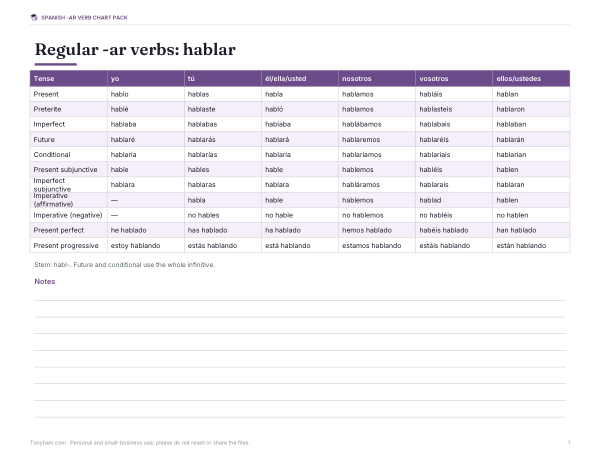
Regular -ar endings
| Tense | yo | tú | él/ella/usted | nosotros | vosotros | ellos/ustedes |
|---|---|---|---|---|---|---|
| Present | hablo | hablas | habla | hablamos | habláis | hablan |
| Preterite | hablé | hablaste | habló | hablamos | hablasteis | hablaron |
| Imperfect | hablaba | hablabas | hablaba | hablábamos | hablabais | hablaban |
| Future | hablaré | hablarás | hablará | hablaremos | hablaréis | hablarán |
| Conditional | hablaría | hablarías | hablaría | hablaríamos | hablaríais | hablarían |
| Present subjunctive | hable | hables | hable | hablemos | habléis | hablen |
| Imperfect subjunctive | hablara | hablaras | hablara | habláramos | hablarais | hablaran |
The model verb is hablar (to speak). Remove -ar to find the stem (habl-) and add the endings; the future and conditional add their endings to the whole infinitive (hablar-é, hablar-ía).
Stem-changing -ar verbs
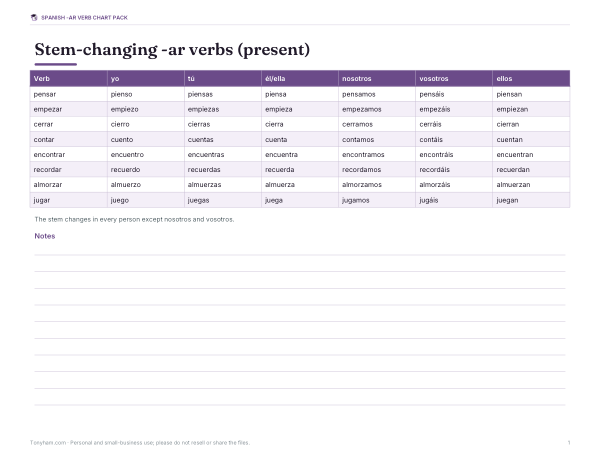
Some -ar verbs change the vowel in their stem when it is stressed: e becomes ie (pensar → pienso) and o becomes ue (contar → cuento); jugar changes u to ue (juego). The change happens in the present indicative, the present subjunctive and the related commands — in every person except nosotros and vosotros, where the stress falls on the ending. -ar stem-changers do not change in the preterite.
| Type | Examples |
|---|---|
| e → ie | pensar, empezar, comenzar, cerrar, despertar, sentar, calentar, recomendar, nevar, negar, fregar, gobernar, temblar, confesar, atravesar, apretar, merendar |
| o → ue | contar, encontrar, recordar, mostrar, costar, probar, soñar, volar, almorzar, acostar, colgar, rogar, sonar, tronar, forzar |
| u → ue | jugar |
Spelling changes: -car, -gar, -zar
| Ending | Change before e | Preterite yo | Present subjunctive |
|---|---|---|---|
| -car | c → qu | busqué | busque |
| -gar | g → gu | llegué | llegue |
| -zar | z → c | empecé | empiece |
| -guar | gu → gü | averigüé | averigüe |
These changes keep the pronunciation of the stem consonant the same. They are regular in sound — just spelled differently.
Worked example: empezar
Empezar (to begin) is both stem-changing (e → ie) and a -zar verb. Present: empiezo, empiezas, empieza, empezamos, empezáis, empiezan. Preterite: empecé, empezaste, empezó, empezamos, empezasteis, empezaron — note empecé with c, and no stem change. Present subjunctive: empiece, empieces, empiece, empecemos, empecéis, empiecen — stem change and z → c together, except in nosotros and vosotros. The chart highlights each of these forms.
Irregular -ar verbs
| Verb | Present yo | Preterite yo | Subjunctive yo |
|---|---|---|---|
| estar | estoy | estuve | esté |
| dar | doy | di | dé |
| andar | ando | anduve | ande |
Only a handful of -ar verbs are truly irregular. Estar and dar change in several tenses; andar changes only in the preterite and imperfect subjunctive. Verbs like enviar and continuar take a written accent on the stem in stressed forms (envío, continúo).
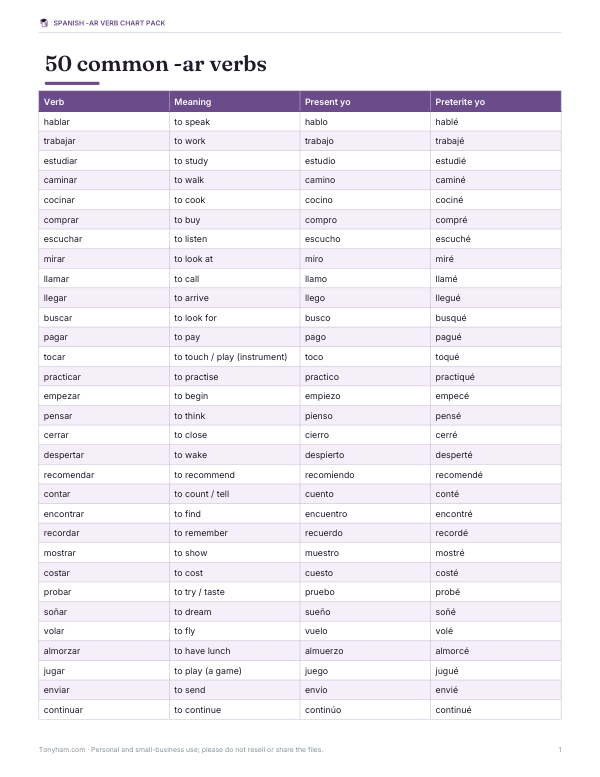
50 common -ar verbs
| Verb | Meaning | Verb | Meaning |
|---|---|---|---|
| hablar | to speak | soñar | to dream |
| trabajar | to work | volar | to fly |
| estudiar | to study | almorzar | to have lunch |
| caminar | to walk | jugar | to play (a game) |
| cocinar | to cook | enviar | to send |
| comprar | to buy | continuar | to continue |
| escuchar | to listen | estar | to be (state, location) |
| mirar | to look at | dar | to give |
| llamar | to call | andar | to walk / go |
| llegar | to arrive | bailar | to dance |
| buscar | to look for | cantar | to sing |
| pagar | to pay | nadar | to swim |
| tocar | to touch / play (instrument) | viajar | to travel |
| practicar | to practise | ayudar | to help |
| empezar | to begin | necesitar | to need |
| pensar | to think | preguntar | to ask |
| cerrar | to close | tomar | to take / drink |
| despertar | to wake | usar | to use |
| recomendar | to recommend | ganar | to win / earn |
| contar | to count / tell | lavar | to wash |
| encontrar | to find | limpiar | to clean |
| recordar | to remember | descansar | to rest |
| mostrar | to show | esperar | to wait / hope |
| costar | to cost | entrar | to enter |
| probar | to try / taste | terminar | to finish |
How to learn -ar conjugations fast
- Master the present tense of hablar, then apply it to five new verbs a day.
- Learn the preterite endings next — é, aste, ó, amos, asteis, aron — noting the accents.
- Group stem-changers with a picture: the “boot” shape covers the persons that change (yo, tú, él, ellos).
- Say forms aloud in short sentences: Hablo español. ¿Hablas inglés?
- Use the quiz daily for five minutes and review any verb you miss.
Because the endings are identical for every regular -ar verb, each new verb you learn costs almost nothing once the pattern is automatic.
Present vs preterite vs imperfect
| Tense | Use | Example |
|---|---|---|
| Present | Now, habits and general truths | Trabajo en una oficina. |
| Preterite | Completed actions at a specific time | Ayer trabajé diez horas. |
| Imperfect | Past habits, background and ongoing states | Cuando era niño, trabajaba en la tienda de mi padre. |
| Present perfect | Past actions connected to now (common in Spain) | Hoy he trabajado mucho. |
| Present progressive | Actions in progress right now | Estoy trabajando. |
Reflexive -ar verbs
For reflexive verbs such as levantarse or ducharse, conjugate the verb without -se and put the pronoun before each form: me levanto, te levantas, se levanta, nos levantamos, os levantáis, se levantan. In affirmative commands the pronoun attaches to the end and an accent is often added (levántate).
Privacy
Everything runs in your browser.
Frequently asked questions
How do you conjugate -ar verbs?
Remove -ar and add the endings for the tense and person, e.g. hablo, hablas, habla.
What is the preterite of -ar verbs?
é, aste, ó, amos, asteis, aron — hablé, hablaste, habló…
Which -ar verbs are irregular?
Mainly estar, dar and andar (in the preterite); many others have stem or spelling changes.
Why does buscar become busqué?
The c changes to qu before e to keep the hard k sound.
Do stem changes happen in nosotros?
No — not in the present tense of -ar verbs.
Can I type answers without accents?
Yes — tick the option to accept them.
Why do some -ar verbs have accents like envío?
Verbs such as enviar and continuar stress the i or u in some forms, which is marked with a written accent.
Is jugar an -ar stem changer?
Yes — it is the only common verb that changes u to ue: juego, juegas, juega.
Which tense should beginners learn first?
The present tense, then the preterite.